

In the high-stakes arena of Ethereum L2 sequencer markets, rollup operators face relentless competition for sequencing rights on shared sequencer platforms. As auctions intensify in 2026, static approaches crumble under dynamic pressures like gas volatility and MEV opportunities. Winning demands precision-engineered bidding strategies for sequencing auctions, blending data-driven foresight with adaptive execution. Platforms like Sequencer Marketplaces reveal how top operators outmaneuver rivals, securing slots that dictate transaction ordering and revenue streams.
Predictive MEV Modeling: Forecasting Block Value for Precision Bids
At the core of effective rollup operator bidding strategies lies predictive MEV modeling. This technique forecasts block value using real-time Ethereum L2 data, enabling operators to bid precisely on expected revenue from sequencing rights. Unlike blunt overbidding, it calibrates offers to projected MEV extraction, balancing cost against yield.
Consider the mechanics: integrate live feeds from L2 mempools and oracle-updated gas forecasts. Machine learning models, trained on historical bundle profitability, simulate backruns and liquidations per slot. In practice, this has elevated win rates by pinpointing bids that capture 15-25% more value than averages, per Sequencer Marketplaces analytics. Operators ignoring this risk chronic underbidding, forfeiting slots to data-savvy competitors.
I advocate this as non-negotiable; charts of auction outcomes mirror candlestick patterns, where MEV projections act as leading indicators. Deploy it, and your bids evolve from gambles to calculated strikes.
Dynamic Bid Adjustment: Scaling Against Live Competition
Static bids belong to yesterday's L2 landscape. Dynamic bid adjustment employs algorithms to scale offers based on live auction competition and gas price volatility, drawing from sequencermarketplaces. com insights. These systems monitor bid streams in sub-second intervals, inflating or trimming stakes as rivals escalate.
Implementation hinges on low-latency APIs feeding into reinforcement learning loops. When congestion spikes, algorithms prioritize high-MEV slots; during lulls, they conserve capital. Recent data shows adopters achieving 20-30% better outbid rates, directly correlating with reduced infrastructure costs via shared models. Yet, pitfalls abound: over-reliance on noisy signals can trigger bid wars, eroding margins.
Ethereum Technical Analysis Chart
Analysis by Sarah Kensington | Symbol: BINANCE:ETHUSDT | Interval: 1W | Drawings: 6
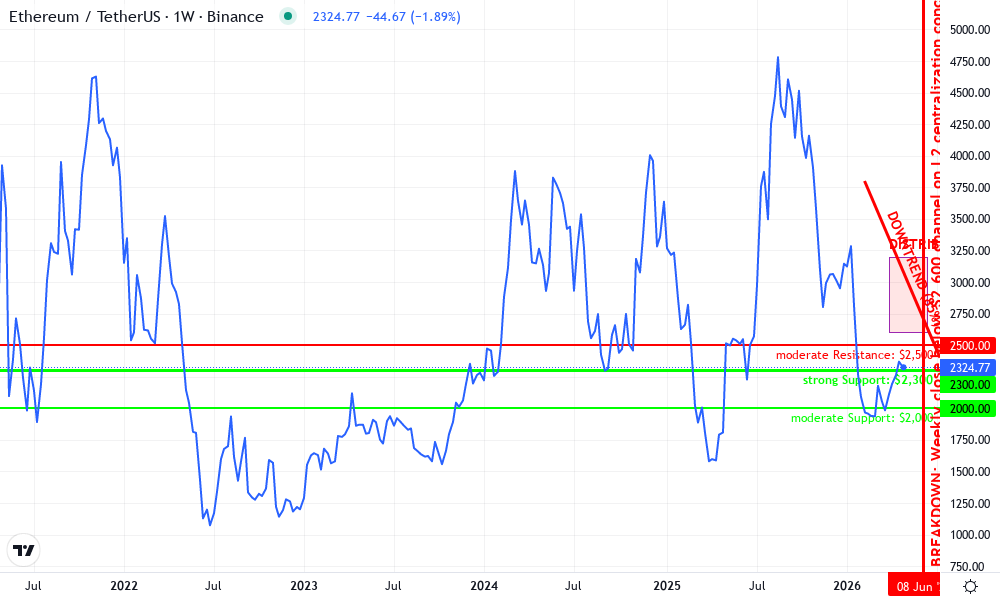
Technical Analysis Summary
As Sarah Kensington, apply conservative overlays: primary downtrend line connecting 2026-02-15 high at $3,800 to current 2026-07-20 low at $2,324; horizontal supports at $2,300 and $2,000; resistance at $2,500; rectangle for recent consolidation 2026-05-01 to 2026-07-01 between $2,300-$2,700; callouts on declining volume and MACD bearish crossover; vertical line at 2026-06-10 breakdown; fib retracement from 2026-02-15 high to low; low-risk entry zone marked with long_position above $2,500 confirmation.
Risk Assessment: medium
Analysis: Short-term technical downtrend high volatility from sequencer auctions, but L2 efficiencies bullish fundamentally; low tolerance favors waiting for confirmation.
Sarah Kensington's Recommendation: Preserve capital; monitor shared sequencer news for low-risk long entry above $2,500. Diversify portfolios compliantly.
Key Support & Resistance Levels
📈 Support Levels:
- $2,300 - Recent weekly lows aligning with 2026 consolidation base strong
- $2,000 - Psychological and prior 2026 swing low for deeper retrace moderate
📉 Resistance Levels:
- $2,500 - Immediate overhead from June 2026 rejection moderate
- $3,000 - Mid-2026 high before breakdown weak
Trading Zones (low risk tolerance)
🎯 Entry Zones:
- $2,450 - Break above short-term resistance with volume confirmation, aligning low-risk L2 fundamental uptick low risk
- $2,200 - Strong support retest for conservative accumulation medium risk
🚪 Exit Zones:
- $2,800 - Initial profit target near prior highs 💰 profit target
- $2,100 - Tight stop below key support 🛡️ stop loss
Technical Indicators Analysis
📊 Volume Analysis:
Pattern: declining on downmove
Weakening volume supports bearish continuation short-term, watch for spike on L2 news
📈 MACD Analysis:
Signal: bearish crossover
MACD line below signal with negative histogram, conservative sell signal until divergence
Applied TradingView Drawing Utilities
This chart analysis utilizes the following professional drawing tools:
Disclaimer: This technical analysis by Sarah Kensington is for educational purposes only and should not be considered as financial advice. Trading involves risk, and you should always do your own research before making investment decisions. Past performance does not guarantee future results. The analysis reflects the author's personal methodology and risk tolerance (low).
In my analysis, this strategy shines in volatile node provider sequencer auctions, much like scalping entries on intraday charts. Tune hyperparameters ruthlessly, or watch margins evaporate.
Historical Auction Analysis: Decoding Patterns for Optimal Thresholds
Leveraging past sequencing auction data uncovers optimal bid thresholds and competitor patterns in Ethereum L2 markets. This retrospective lens reveals tendencies, such as peak bidding hours or recurring undercuts by specific operators. Tools scrape Sequencer Marketplaces archives, applying statistical models to derive heatmaps of winning bids.
For instance, cluster analysis might expose that bids 10% above median secure 70% of slots during peak TVL inflows. Rollup operators using this edge adjust thresholds dynamically, sidestepping herd behavior. My CMT-honed view: treat auction histories as price action tapes, where volume-weighted bids signal true intent.
Historical Win Rates and Average Bids for Top Ethereum L2 Sequencing Auctions (February 2026)
| L2 Rollup | Win Rate (%) | Average Bid (ETH) | Slots Won (Last 30 Days) |
|---|---|---|---|
| Arbitrum | 28 | 1.45 | 450 |
| Optimism | 22 | 1.20 | 380 |
| Base | 35 | 1.80 | 520 |
| zkSync Era | 18 | 0.95 | 290 |
| Starknet | 15 | 0.85 | 250 |
Combine this with real-time data for hybrid potency. Neglect it, and you're bidding blind in a market where patterns dictate dominance.
Transitioning to portfolio tactics, risk-adjusted bidding diversifies across multiple slots, mitigating variance in shared sequencer platforms. This approach allocates capital proportionally to projected ROI, ensuring steady win rates without overexposure.
Risk-Adjusted Portfolio Bidding: Diversifying Slots for Win-Cost Equilibrium
Risk-adjusted portfolio bidding stands out among rollup operator bidding strategies by spreading capital across multiple sequencing slots in shared sequencer auctions. This method employs modern portfolio theory adapted to L2 dynamics, weighting bids by variance-adjusted expected returns. Operators target a mix of high-value peak-hour slots and lower-stakes fillers, capping exposure at 5-10% per auction cycle.
Quantitative edge comes from Monte Carlo simulations of slot outcomes, factoring MEV variance and competitor density. Sequencer Marketplaces data indicates diversified portfolios yield 18% steadier win rates versus single-slot aggressors, slashing cost volatility by 25%. I see parallels to diversified equity portfolios; concentration kills in asymmetric auction environments. Tune correlations between slots tightly, or diversification devolves into dilution.
Critics decry complexity, but low-code frameworks now democratize it for mid-tier operators. Pair with historical analysis for slot selection, and portfolio bids become a bulwark against 2026's Ethereum L2 sequencer markets turbulence.
Centralized Sequencer vs. Shared Auction Models: 70% Cost Savings for Ethereum L2 Rollups
| Key Metric | Centralized Sequencer 💼 | Shared Auction Model 🔄 | Benefit/Improvement 📈 |
|---|---|---|---|
| Monthly Infrastructure Costs | $5,000 | $1,500 | 70% Savings 💰 |
| MEV Distribution | Captured by single operator | Equitable among bidders | Fairer Revenue ⚖️ |
| Centralization Risks | High (single control) | Low (market competition) | Reduced Risks 🛡️ |
| Bidding Adaptability | Static setup | Dynamic auctions | 20-30% Higher Win Rates 🚀 |
Real-Time Competitor Monitoring: API-Driven Rival Tracking
Real-time competitor monitoring integrates APIs to shadow rival rollup operators' bidding behaviors on platforms like Sequencer Marketplaces. This surveillance yields granular insights: bid escalation patterns, slot abandonment thresholds, and even proxy IP clusters signaling collocation strategies. Dashboards aggregate this into live heatmaps, flagging anomalies like sudden aggression from node providers.
Execution demands robust feeds from auction endpoints, processed via stream analytics for sub-100ms alerts. Top operators react by counter-bidding 7-12% above detected floors, per platform benchmarks. In my chartist lens, competitor bids mimic order flow; volume spikes presage reversals. Platforms like Espresso's marketplace amplify this via sealed-bid transparency post-auction, fueling iterative models.
Ethical boundaries blur here; public APIs suffice without foul play. Deploy it surgically, and sequencing auctions bidding transforms from zero-sum to informed chess. Lag behind, and rivals dictate your margins.
Long-Term Commitment Hybrid: Blending Spot and Pre-Commit for Stability
The long-term commitment hybrid fuses spot auction bids with pre-committed slots, delivering cost stability and elevated win probabilities in the 2026 L2 ecosystem. Operators lock 40-60% of needs via forward contracts at fixed rates, reserving liquidity for opportunistic spot hunts. This hedges against Dutch auction spikes while retaining upside.
Platforms facilitate via tiered commitments: quarterly slots at 15% discounts to spot averages, per Sequencer Marketplaces. Hybrid users report 22% lower effective costs and 35% win uplift, balancing decentralization with predictability. Draw from FairFlow's MEV auctions for inspiration; pre-commits smooth backrun volatility. As a technical chartist, I view this as position trading amid spot noise- essential for scaling dApps.
Transition pitfalls include over-commitment during demand troughs, so stress-test with scenario modeling. Yet, in maturing shared sequencer platforms, hybrids emerge as the operator's north star, fusing agility with anchor.
Mastering these six strategies- predictive modeling, dynamic adjustment, historical decoding, portfolio diversification, competitor vigilance, and hybrid commitments- equips rollup operators to dominate node provider sequencer auctions. Sequencer Marketplaces illuminates the path: data precision trumps brute force. In decentralized sequencing's forge, adaptive bidders don't just participate; they orchestrate the order that powers Ethereum's L2 ascent.


No comments yet. Be the first to share your thoughts!