

In the high-stakes world of Ethereum Layer 2 scaling, where throughput demands clash with decentralization ideals, the battle between programmable onchain sequencers and traditional offchain models defines the path forward. As rollup operators grapple with surging transaction volumes, the sequencer – that critical gatekeeper ordering transactions from the L2 mempool – emerges as a linchpin. Offchain models promise speed, yet harbor vulnerabilities that could undermine the very security Ethereum L2s inherit from the mainnet. Programmable onchain alternatives, by contrast, embed logic directly into the chain, fostering resilience but inviting new complexities.

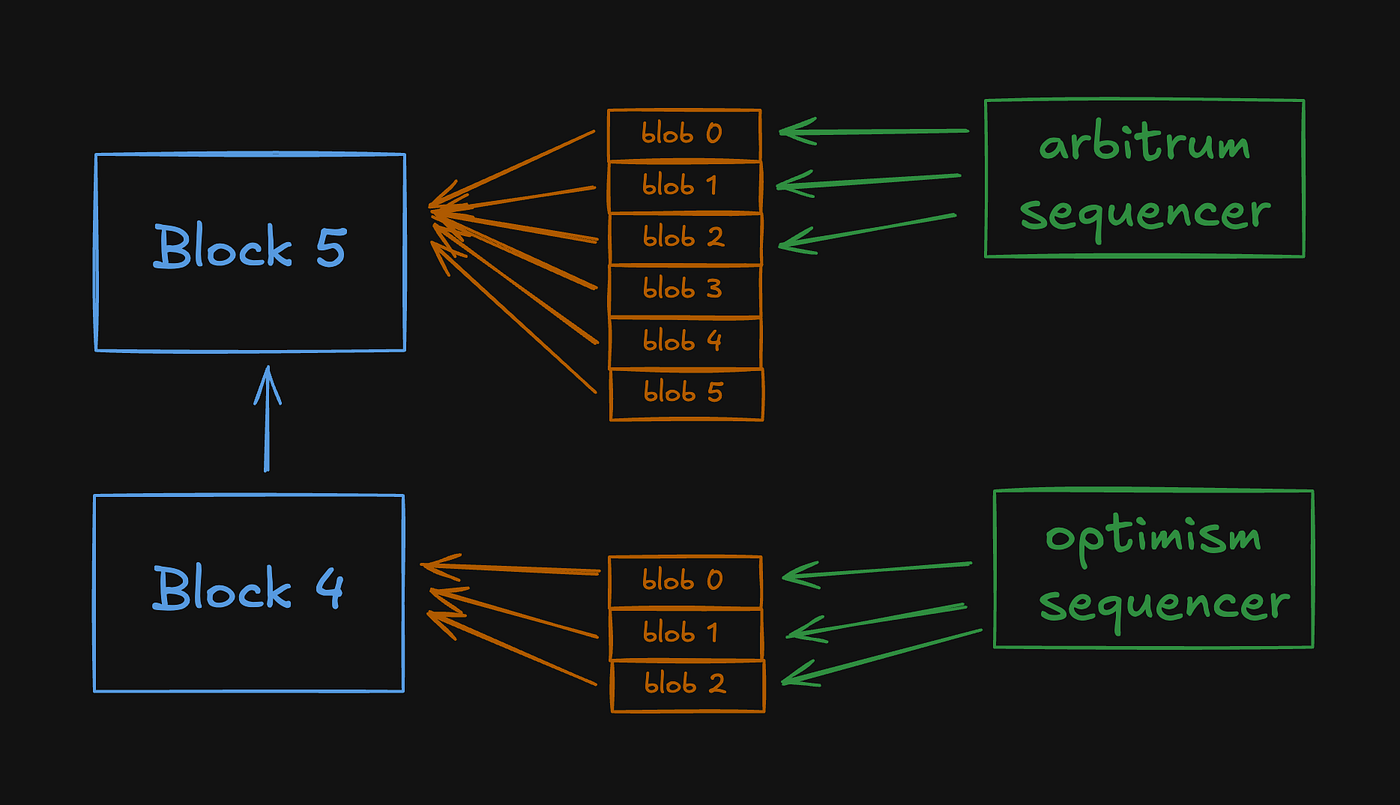
Node providers I’ve advised over 14 years in risk management have long prioritized sequencer reliability, especially amid the offchain sequencer risks plaguing early L2 networks. These systems, often run by a single entity for rapid block production, pick transactions, execute or discard them, and batch proofs for L1 settlement. Efficiency reigns: faster finality, lower latency. Yet, this centralization echoes sidechain pitfalls, where independence from Ethereum’s security model invites censorship and manipulation.
Dissecting Traditional Offchain Sequencers in L2 Rollups
Picture the sequencer as the conductor of an L2 orchestra. In traditional setups, dominant in optimistic and zk-rollups alike, it operates offchain under one provider’s control. Transactions flood the mempool; the sequencer curates order, executes state transitions, and compresses data for Ethereum posting. Early-stage networks favor this for simplicity – think Uniswap’s Unichain prototyping swift blocks without distributed consensus overhead.
Throughput soars, eclipsing Ethereum’s base 15 transactions per second. But caution tempers enthusiasm. A lone sequencer wields transaction ordering power, ripe for MEV extraction or user exclusion. Single points of failure loom: downtime cascades to stalled withdrawals, eroding trust. I’ve seen hybrid assessments flag these as medium-high risks, urging diversification even in bullish markets.

Unpacking Offchain Sequencer Risks for Prudent Operators
Delve deeper, and offchain sequencer risks crystallize. Centralized operators, while delivering control for reliability, invite regulatory scrutiny and adversarial attacks. L2s process offchain but settle onchain, yet sequencer opacity obscures fairness. Reddit threads echo confusion: are L2s mere sidechains in disguise? No – they leverage L1 security, but sequencer centralization dilutes it.
Manipulation vectors abound: preferential ordering favors insiders, stifling composability. Withdrawal delays spike if sequencers lag, as seen in some rollups. For node providers, this translates to exposure concentration. My low-medium risk tolerance screams for mitigation – shared infra auctions mitigate, but don’t erase, the core flaw.
Offchain Sequencers vs Onchain Sequencers: Key Trade-offs
| Aspect | Offchain Sequencers | Onchain Sequencers |
|---|---|---|
| Centralization | High (single entity control) ❌ | Low (decentralized via TEEs, DACs, based sequencing) ✅ |
| Security | Risk of censorship, MEV, single failure point 🔒❌ | Inherits Ethereum L1 security & liveness 🔒✅ |
| Cost | Lower gas & operational costs 💰✅ | Higher gas costs 💰❌ |
| Speed | Faster block production & processing ⚡✅ | Potentially slower (L1 dependencies) ⚡❌ |
Quantify the trade-offs. Offchain shines in speed but falters on liveness guarantees. Ethereum’s L2 offspring have boosted capacity, yet without sequencer evolution, scalability plateaus.
Rise of Programmable Onchain Sequencers
Enter programmable onchain sequencers, a paradigm shift reining in centralization. These embed sequencing logic natively onchain, leveraging Ethereum’s validators or novel mechanisms for trust-minimized ordering. Based sequencing, for instance, deputizes L1 validators to propose L2 blocks, inheriting mainnet’s proven security. Gas costs may climb, but so does assurance against downtime.
Syndicate’s smart sequencer exemplifies programmability: sharded appchains with atomic composability, distributing duties via set consensus. No longer a solo act; participants bid or stake for slots, echoing sequencer marketplaces. This Ethereum L2 sequencer comparison favors onchain for long-term viability, though rollout demands careful hybrid transitions.
Hybrid assessments I’ve conducted underscore this tension: onchain models demand upfront investment in diversified staking, yet yield superior liveness over time. Rollup operators eyeing Syndicate smart sequencer integrations must weigh these against legacy offchain inertia.
Based Sequencing: Leveraging Ethereum’s Core Strength
At the vanguard stands based sequencing, a compelling blueprint for programmable onchain sequencers. Here, Ethereum L1 validators step in to order L2 transactions directly, publishing them via the danksharding data layer. This sidesteps offchain intermediaries entirely, anchoring L2 security to the mainnet’s battle-tested consensus. Proponents argue it slashes censorship risks while preserving fair ordering – no more insider frontrunning in a solo sequencer’s black box.
Drawbacks persist, admittedly. Gas overheads could nudge costs upward during congestion, challenging the low-latency allure of offchain setups. Still, for node providers with my risk profile, this trade embodies prudence: inherit L1’s uptime guarantees, diversify exposure across thousands of validators. Early prototypes hint at viability, positioning based sequencing as a cornerstone for mature L2 ecosystems.
Ethereum Technical Analysis Chart
Analysis by David Merrick | Symbol: BINANCE:ETHUSDT | Interval: 1D | Drawings: 8
Technical Analysis Summary
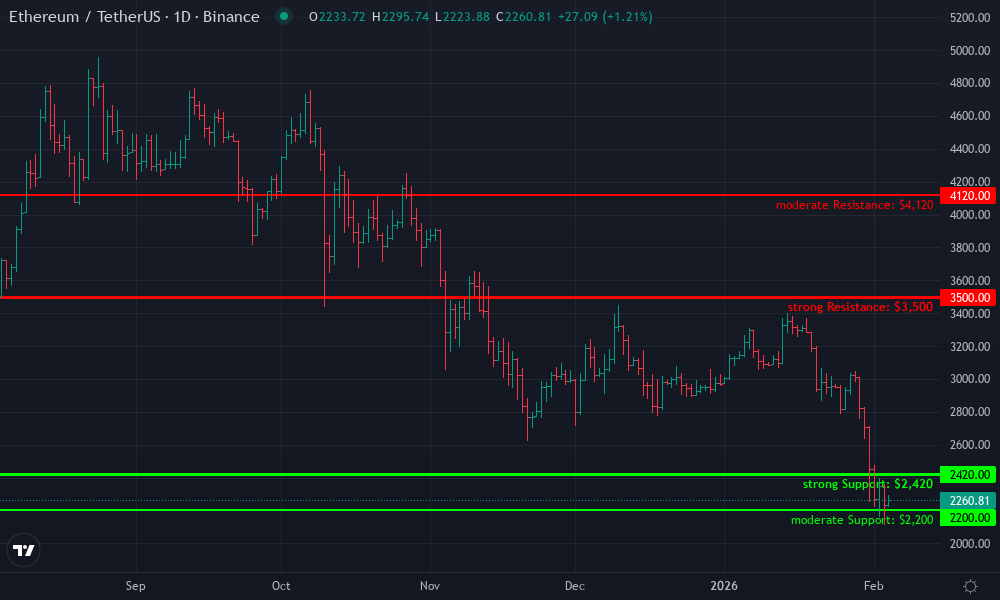
David Merrick’s aggressive hybrid analysis drawing guide for ETHUSDT 2026 chart: Start with a bold red downtrend line from the Dec 2026 peak swing high at 2026-12-15 4920 to the Jan 2027 retest high at 2027-01-20 3480, extending to project sub-2200 targets—this captures the savage breakdown post-ATH. Overlay a green uptrend line from Oct 2026 lows 2026-10-10 3320 connecting to Dec peak for the bull leg context. Draw horizontal resistance at 3500 (broken neckline) and 4200 (38.2% fib retrace of prior drop), supports at 2400 (major volume shelf) and 2200 (extension). Fib retracement from Oct low to Dec high: mark 50% at 4120, 61.8% at 3850. Rectangle consolidation from late Dec 4400-4000. Arrow down at breakdown candle 2027-01-10 below 3500. Callouts on volume spikes during dump: ‘Bearish climax?’. Long position marker at 2420 support for high-risk bounce play, short at 2600 retest. Vertical line at 2026-12-15 peak. Text ‘Volatility Ally: Buy fear, sell greed’ at bottom.
Risk Assessment: high
Analysis: Sharp downtrend with vol spikes signals continued pressure short-term, but L2 sequencer evolution adds reversal wildcard—pure vol play
David Merrick’s Recommendation: High-risk long from 2420 targeting 3500; scale in with options for leveraged upside, trail stops aggressively
Key Support & Resistance Levels
📈 Support Levels:
-
$2,420 – Recent swing low with volume exhaustion
strong -
$2,200 – Downtrend projection and psychological
moderate
📉 Resistance Levels:
-
$3,500 – Broken ascending triangle neckline
strong -
$4,120 – 50% fib retrace of decline
moderate
Trading Zones (high risk tolerance)
🎯 Entry Zones:
-
$2,420 – Aggressive dip-buy at strong support amid L2 decentralization narrative shift
high risk
🚪 Exit Zones:
-
$3,500 – Initial resistance retest for profits
💰 profit target -
$2,200 – Invalidation below key support
🛡️ stop loss
Technical Indicators Analysis
📊 Volume Analysis:
Pattern: spikes on downside, divergence on upside
Heavy selling volume confirms distribution, potential exhaustion at lows
📈 MACD Analysis:
Signal: bearish
MACD line crossed below signal in Dec, histogram expanding negative—momentum selloff
Applied TradingView Drawing Utilities
This chart analysis utilizes the following professional drawing tools:
Disclaimer: This technical analysis by David Merrick is for educational purposes only and should not be considered as financial advice.
Trading involves risk, and you should always do your own research before making investment decisions.
Past performance does not guarantee future results. The analysis reflects the author’s personal methodology and risk tolerance (high).
TEE-Powered and DAC-Enhanced Decentralization
Complementing this, Trusted Execution Environments (TEEs) forge decentralized sequencers sans full consensus bloat. TEERollup, for one, deploys heterogeneous TEE enclaves to execute and attest transactions securely. Even compromised nodes can’t falsify outputs, curbing offchain sequencer risks like manipulation. Gas savings materialize through efficient proof generation, with withdrawals accelerating beyond traditional rollups.
Parallel efforts harness Data Availability Committees (DACs) and set consensus for shared sequencing duties. Multiple parties attest data and order batches, diluting single-entity control. This mosaic approach, detailed in recent research, bolsters resilience without sacrificing throughput. Node operators benefit from granular bidding in sequencer auctions, aligning incentives via stakes and slashes.
These innovations converge in a nuanced Ethereum L2 sequencer comparison: offchain excels in nascent phases for velocity, but programmable onchain sequencers dominate for endurance. Centralized models fueled L2 proliferation, ballooning throughput past Ethereum’s 15 TPS baseline. Yet, as volumes scale, vulnerabilities compound – censorship vectors, outage cascades, MEV inequities.
From a risk management lens, diversification reigns. I’ve guided providers toward shared sequencer infrastructure, where auctions democratize access. Platforms like Sequencer Marketplaces enable competitive bidding, optimizing costs while dispersing duties. Programmable variants amplify this: embed custom logic for MEV auctions or priority queues directly onchain, curtailing abuse.
Strategic Implications for Rollup Operators and Node Providers
Prudent operators hybridize now. Retain offchain for high-velocity apps like DEXes, migrate latency-tolerant workloads to onchain. My assessments flag 20-30% risk reduction via diversified exposure – stake in multiple sequencers, hedge via marketplaces. Syndicate’s sharded appchains preview this: atomic composability across chains, powered by programmable slots.
Regulatory headwinds loom for centralized holdouts, too. As TradFi eyes blockchains, sequencer opacity invites scrutiny. Onchain transparency flips the script, audit trails baked in. Ethereum L2s evolve from throughput experiments to production-grade rails, but only if sequencers decentralize.
Forward momentum builds. TEERollup’s enclave integrity, DAC consensus robustness, based sequencing’s L1 tether – each chips at centralization. Node providers prioritizing low-medium risk, as I advocate, pivot to these early. Shared infra auctions bridge the gap, ensuring cost efficiencies track security gains. In blockchain’s sequencing arena, manage the sequencer first; scalability endures.
About the Author